
Evidence
Content elaborated from: Examples of evidence to support a student's inclusion in the NCCD
Information on PC entries for SWAN&SEE Staff can be found here.
Linking PC Records to NCCD Evidence Capture using TAGs
All evidence is recorded in Schoolbox Pastoral Care as 'PC Records' and is then tagged where appropriate with the following 'TAGS':
- SWAN-Evidence-Assessed Individual Needs
- SWAN-Evidence-Adjustments
- SWAN-Evidence-Monitoring & Review
- SWAN-Evidence-Consultation & Collaboration
This allows for records to have multiple TAGs and reduces the need for records to be duplicated. For example:
- an email chain between parents and teachers may include:
- evidence of assessed individual needs
- parental report of disability in conjunction with evidence of an assessed individual need
- evidence of adjustments
- teacher reply with adjustments made in class
- evidence of monitoring & review
- modifications made to the adjustment over time including reflections
- evidence of consultation & collaboration
- the email chain itself
- evidence of assessed individual needs
An email chain of this nature can include all of the 'SWAN-Evidence' tags above.
SWAN staff are able to retrospectively apply TAGs where appropriate leading up to an audit.
Below is a breakdown of the different types of evidence and examples of what is included in each type.
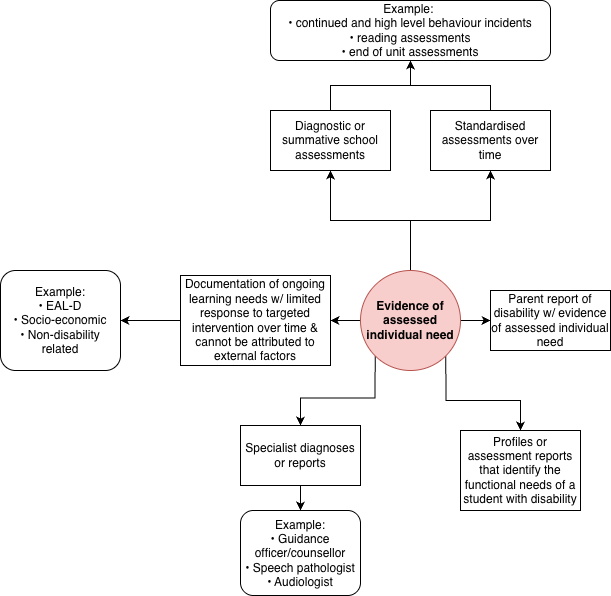
Evidence of assessed individual needs
- results of diagnostic or summative school and/or standardised assessments over time documenting an ongoing learning or socio-emotional need arising from a disability (eg continued and high level behaviour incidents, reading assessments or end-of-unit assessments)
- documentation of ongoing learning needs that have a limited response to targeted intervention over time and cannot be attributed to external factors, such as English as an additional language or dialect, socioeconomic or non-disability related causes
- parental report of disability in conjunction with evidence of an assessed individual need
- specialist diagnoses or reports, for example from a medical practitioner such as a paediatrician, or other medical specialist such as a guidance officer/counsellor, speech pathologist or audiologist
- profiles or assessment reports that identify the functional needs of a student with disability.
No comments to display
No comments to display